Our Saints
In the Orthodox Church, the saints are an important and beautiful part of our faith. Saints are men and women who have faced the evils of this world and through their love of God, and strength of faith have overcome the evils by the grace of God and have become examples for us to do the same. They lived lives of extraordinary faith, love, and devotion to God, offering us examples of what it means to follow Christ in every time and circumstance. We honor the saints not as gods, but as members of the family of Christ who have gone before us and who continue to pray for us. Through the hardships in their lives, even to the point of their deaths, their writings, and icons, we are encouraged and inspired in our own journey toward Christ, reminded that holiness is not reserved for a select few but is a calling for each of us. For this reason we honor them.
Our Patron Saints
Holy Trinity
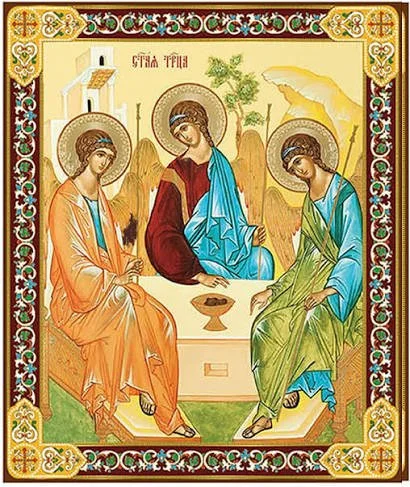
The icon of the Hospitality of Abraham is one of the most beloved images in the Orthodox Church. The image depicts the scene from Genesis 18:1-15, when Abraham and Sarah welcomed three strangers to rest and dine at their tent. The strangers announce that by the time of their return trip, Sarah will have borne a son. Because of her advanced age, Sarah laughed at this news, but the visitors say, “Is anything too wonderful for the Lord?” Of course, the son is born: Isaac (Genesis 21:1-7)
The icon is also called “The Holy Trinity” because the three strangers can be understood to be a revelation of the Holy Trinity. Throughout the story, the speakers are named as “the Lord.”Examining the icon more closely, we see a single tree in the background, representing the oaks of Mamre–a place where caravans of nomads and shepherds would gather, not too far from modern-day Hebron. The building represents Abraham’s tents.
The three visitors are depicted as angels, not because the story says they are angelic figures–they are called “men”–but because of their announcing that Sarah will give birth. Each holds a walking stick. A regular question is, “Which one is the Father, which is the Son, and which is the Holy Spirit?” The icon does not tell us. Some have said that the Father sits at the head of the table–in the center–with the Son to His right. Others have said it is the Son who is seated at the head.
Prophet Elias

One of the most holy prophets of the Old Testament. He lived in the 9th century B.C., during the reign of the sinful King Ahab, King of Israel, who worshipped the idol of Baal.
Prophet Elias, also known as Elijah, was wise and faithful to the true God. God sent Prophet Elias to speak the truth to King Ahab and his evil wife Jezebel. But to no avail. Not only did King Ahab not listen to Prophet Elias, but he threatened to kill him. To escape, Prophet Elias fled to a mountain. There he stayed and hid in a cave. Everyday, God sent a crow with meat and bread to feed Prophet Elias. He would drink from a nearby stream. But there was a drought in the land. Prophet Elias had prophesied that it would last for 3 years as a punishment for the faithlessness of King Ahab and Queen Jezebel. So in time, the stream dried up.
With no water, Prophet Elias had no choice but to leave his mountain hideout. On his way, he met a poor widow with her only son. The unfortunate woman accepted to give Prophet Elias a place to stay, despite her poverty. She had only a little flour and oil with which to make all their food. However, Prophet Elias miraculously increased the amount of flour and oil so that all three people had enough to eat for a long time. Then, when the widow’s son fell ill and died, Prophet Elias performed a second miracle and brought him back to life.
The drought, though, continued. For three whole years, not a drop of water fell. The people suffered and many died from hunger. God sent Prophet Elias to appear before King Ahab. Upon seeing Prophet Elias, the sinful King Ahab said to him, “Is it you, you troubler of Israel?” Prophet Elias responded, “I have not troubled Israel; but you and your people have because you have forsaken the commandments of the Lord.” [3 Kings 18:17,18 (LXX)] To show them that the Lord is the true God and that Baal is truly false, Prophet Elias offered King Ahab a challange. He told the King to gather his people and priests the next day. Prophet Elias and the priests of Baal would each make offerings to their own God. No one would have fire. Then they would let the true God send fire from the heavens to light the wood and make the burnt offering.
King Ahab accepted the challange. The next day they all gathered on Mt. Carmel. The priests of King Ahab made their offerings upon their altar. They danced around their altar, pleading with Baal to send fire from the heavens. But nothing happened.
Then, Prophet Elias drew near to his altar and made his offering. He ordered the people to pour water abundantly on the wood. Before the crowd, he knelt and prayed to the true God, “O Lord, God of Abraham, Isaac, I ask you O Lord, hear my prayer and send fire upon this sacrifice that all may know that You are the Lord God of Israel” [3 Kings 18:36 (LXX)] Prophet Elias had bearly finished his prayer when a great fire descended from the heavens and consumed the wood and the offering.
When the gathered crowds saw the miracle, they believed in the true God. Prophet Elias then prayed for rain, and a great rain fell. All the people glorified the true God.
Finally, when his earthly life was over, God decided to bring Prophet Elias close to him without his tasting death. One day, when Prophet Elias was resting near the Jordan River with his disciple Elisha, who was to become a prophet also, a fiery chariot descended from the heavens and took up Prophet Elias. As he was ascending to the heavens, he threw his cloak down to Elisha. With this cloak, Prophet Elisha performed many miracles as well.
We celebrate the memory of Prophet Elias, as well as his presence among us, on July 20th.
Why do the Orthodox Pray to the Saints?
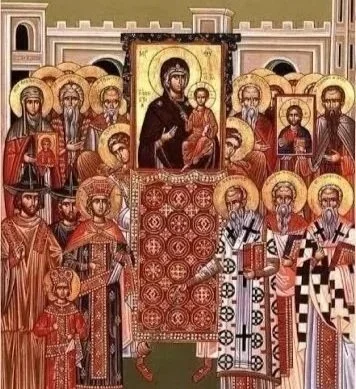
In the Orthodox Church, we ask the saints to pray for us just as we might ask a trusted friend or family member to pray for us. We believe that those who have died in Christ remain alive in Him and continue to be part of the Church, united with us through Christ. When Orthodox Christians “pray to” a saint, we are not worshiping that saint; rather, we are asking for their intercession before God, while recognizing that all grace, help, and salvation ultimately come from God alone.
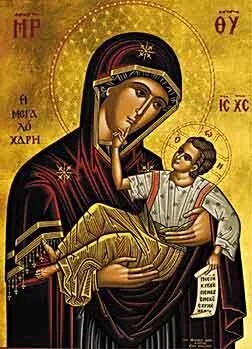
Our Most Holy Theotokos
Our Most Holy Theotokos, the Virgin Mary, holds a uniquely honored place in the Orthodox Church because she freely said “yes” to God and became the mother of Jesus Christ, our Lord and Savior. The title Theotokos, meaning “God-bearer” or “Mother of God,” expresses the Church’s belief that the child she bore is truly God and truly man. Orthodox Christians honor her for her extraordinary faith, humility, and obedience to God and look to her as the greatest example of a lifevoted te do Christ. We do not worship the Theotokos—worship belongs to God alone—but we love and venerate her and ask for her prayers, just as Christians have done throughout the life of the Church.
“To thee, the Champion Leader, we thy servants dedicate a feast of victory and thanksgiving, as ones rescued out of sufferings, O Theotokos; but as thou art one with might which is invincible, from all dangers that can be do thou deliver us, that we may cry to thee: Rejoice, thou Bride Unwedded!”